
by Larry “Mr. Whitetail” Weishuhn
It started innocently enough. I was on the Becker Bottom Ranch in northeast Texas, east of Dallas, visiting with Edgar and David Cotton about their ongoing wildlife management program.
T
exas’ Managed Land Deer Permit season had ended February 28, and we were, among other things, preparing the annual report.
“Larry, when we hunted black bear on the Choctaw Hunting Lodge last October, after David and I took our bears, we made a quick trip through their exotic pasture and saw several oryx. Dusty mentioned he planned on reducing that herd. You think he might still have any left? If so, I would like to talk to him about hunting one.” said Edgar.
I recalled a very recent conversation with Dusty Vickrey, who manages the Choctaw Hunting Lodge, 22,000 acres hunted commercially, complete with a 2,000-acre high-fence, home to several species of exotics, and part of the contiguous 44,000-acre property owned by the Choctaw Nation in southeastern Oklahoma. To me, some of the most beautiful and finest rolling mountain terrain and wildlife habitat to be found anywhere.
Back on Becker Bottom, later that evening, “Gracious! That was a good burger! It didn’t taste quite like beef. What kind of meat was that?” asked Luke Clayton, who had joined us for a quick hog hunt, while we gathered around the campfire. Before anyone could answer, Luke added, “Reminds me of elk!” I could see Edgar and David Cotton smile.
“Pretty good guess. It’s from the elk I shot last October in Colorado”, commented Edgar Cotton.
“Surely delicious. But I have a question for y’all. Have any of you ever eaten any meat from an oryx, either a gemsbok or a scimitar horn? It’s absolutely delicious, tastes somewhat like elk only a little bit better.” I proclaimed, extolling an oryx’s excellent table fare.
“Really? That’s saying a lot!” Replied Edgar. “Guess I’ll have to shoot an oryx…”
A few days earlier, as luck would have it, I had been on Choctaw Hunting Lodge (www.choctawhuntinglodge.com). “Know anyone who wants to shoot a scimitar-horned oryx, a long-horned cow with an interesting deformed horn on one side? She’s truly impressive! And, you know how good oryx meat is! We want to reduce our oryx herd. It’s grown larger than we need.”
I was on the Choctaw with Dusty, looking for a bison bull. I needed photos for an article I was writing about Steve Hornady’s American bison hunt, which he had bought at the 2025 DSC Foundation’s Gala (www.dscf.org), graciously donated by the Choctaw Hunting Lodge.
On cue, as we crossed the top of a ridge, we spotted a small herd of the striking russet and brilliant white colored scimitar horn oryx. Originally from Africa’s Sahara Desert and its fringes, oryx, both bulls and cows grow long, backswept horns, resembling scimitar swords. Bulls generally have more massive horns that are not as long as those of cows. Oryx approaching 40 inches and longer horns are considered the “Holy Grail of Oryxdom”.
The long-horned 300 to 400-pound oryx stared briefly, then departed at a fast trot. There had been just enough time to spot the cow Dusty had previously told me about. Her right horn, like her left, was over 40 inches long but at an angle that put its curled tip over the cow’s left shoulder. Truly unique! She would be a prize to take and behold. Had I not in the past taken a really nice scimitar horn oryx bull, I would have dug in my pocket and taken up the challenge.
Scimitar horn oryx are essentially gone from their native homelands in Africa. Those that exist there today are mostly descendants of reintroduced animals from Texas, where their population on private ranches is 20,000 or more. Because of the efforts of private landowners who allow hunting to support the unique species on their properties, the scimitar horn oryx still exists today and flourishes.
I first hunted scimitar horn oryx on “The Wild Horse Desert” in far southern Texas, where huge herds of wild horses roamed during the early 1800’s. Hunting with Wildlife Systems, I shot a really nice, ancient bull with my .375 Ruger shooting Hornady’s 300-grain DGX Dangerous Game, after a long and fun stalk. In his early life, my bull had broken the tips of his horns, but, during his “golden years,” had polished them so they were again pointed.
Previously, I too had worked as a wildlife management consultant on ranches that had scimitar horned oryx on their property. Doing so, I learned they can be quite dangerous when cornered, wounded, or simply in a nasty mood. I knew of three ranch hands who were skewered and seriously injured by the scimitar-horned oryx.
Over a most delicious meal back at the Choctaw’s comfortable lodge, prepared by Dusty’s wife, Nacolh, “Think I know someone who might want to hunt that oryx we saw this afternoon. You know him!” Dusty stared questioningly in my direction, “Edgar Cotton! He and I talked about hunting oryx last time I was at his Becker Bottom Ranch.” Dusty smiled broadly, recalling Edgar and David.
Edgar and David, at my suggestion, initially hunted Eastern turkeys on the Choctaw. A year later, I asked Dusty if the two could come hunt black bear at the same time I was slated to hunt, the first week of October 2025. Unfortunately, I ended up in the hospital during Oklahoma’s black bear archery season opener and did not get to hunt.
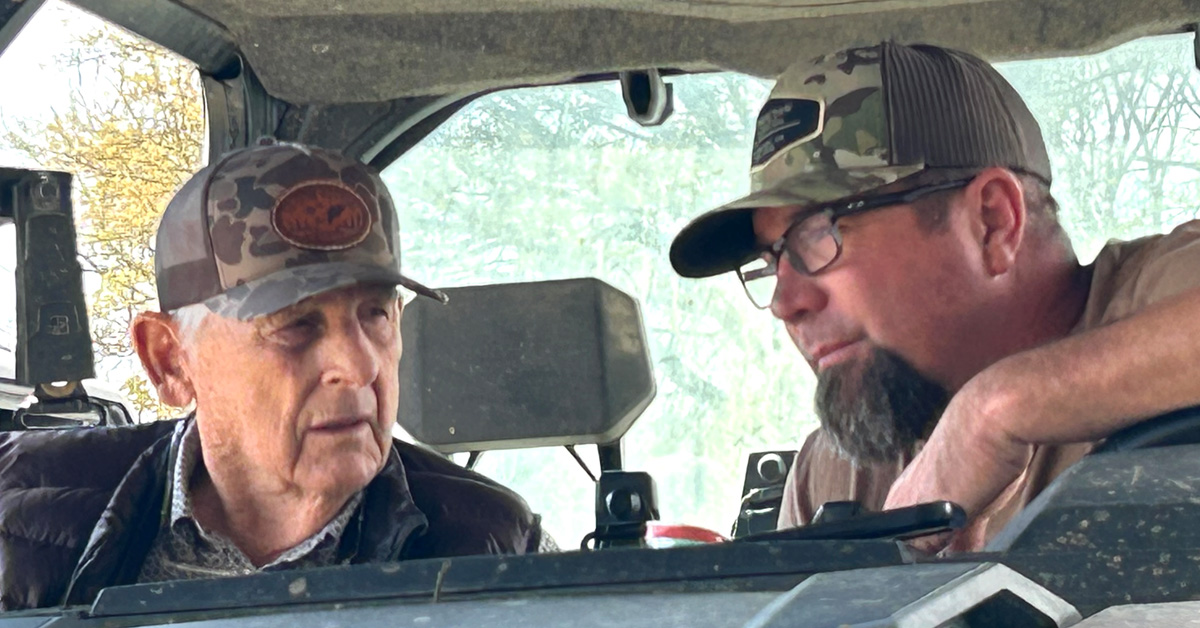
Edgar, then 85, and David, however, were able to make the hunt. Thus, Dusty and I, from my hospital bed, formulated a plan that resulted in both father and son taking bears with their crossbows the first evening of the season out of the same blind. Edgar’s bear weighed 347 pounds. David’s was a little smaller. Thankfully, Jeff Rice was with them in the blind to film their hunt for our weekly “A Sportsman’s Life” television show on CarbonTV.com and also our YouTube Channel of the same title.
Back on the Becker Bottom Ranch with Edgar, David, and Luke, I called Dusty. Moments later, the oryx hunt was on.
Late the next day, after I had made it home, I got a call from David, “Can you please ask Dusty if there’s room in camp for one more person. If there is, Daddy wants to invite Rick Lambert to come up with us.” I loved the idea. Rick, beyond being the father of Emmy Award and just about every other honor that can be bestowed upon a country/western artist, Miranda Lambert, has long been a dear friend and occasional hunting and fishing partner, as has another long-time friend, Jim Zumbo. The three of us are often referred to as “The Three Amigos”.
I planned on being on the Choctaw oryx hunt as well, to help guide.
I arrived at the Choctaw a couple of days before Edgar, David, and Rick, giving Dusty and me time to do some scouting. Prowling the property, Dusty said, “Last time you were here, the oryx were spending most of their time west of the lake near where you and I shot that hornless meat cow. We’ve been putting a lot of pressure on them lately. Now, they’re roaming throughout the pasture. However, the last few days, they’ve been seen around the campground food plot. I had Austin and Terry set up your see-through ground blind there. It’ll easily accommodate the three of you and even Rick if he wants to go with y’all. And, it will be a whole lot cooler than sitting in an enclosed blind. I think hunting from a blind will provide the best opportunity.”
After getting the Cottons and Rick into their respective rooms in the lodge, followed by a delicious afternoon snack, Dusty dropped Edgar, David, and me at my blind for our afternoon vigil. After settling in, Edgar loaded his 6.5 PRC custom rifle with Hornady 143-grain ELD-X Precision Hunter, and adjusted his 5-20X50 Stealth Vision scope (www.stealthvision.com) to 8x; the same rifle/scope/ammo combination he had used to shoot a really nice bull elk in Colorado a few months earlier.
The afternoon’s first animal was a buffalo bull, part of the Choctaw’s bison herd. I noticed Edgar eyeing the bull. After a few minutes, “If I had my handgun or crossbow, that buffalo would be in serious trouble!” Both David and I smiled.
As the afternoon sun started descending behind the west’s tree line, Edgar spotted an oryx walking in the trees to the west. I watched them through my Stealth Vision 10×40 binoculars and soon spotted the odd-angle horned cow. “The one on the far right is the one you want,” I whispered to Edgar and David, who were also scrutinizing the small herd of eight. I switched from binoculars to a camera to procure footage for our “A Sportsman’s Life”.
The long-horned oryx kept moving behind a screening of brush. When a shot might have been possible, she stopped in front of another animal. At one point, she started to walk away. But then stopped and faced our way. “I could try to shoot her where she stands, but there’s brush right in front of her chest… I’ll wait.” whispered Edgar. About then, the oryx Edgar hoped to take, turned and started walking away. Moments later, she stopped, but there was no possible shot. At that point, David and Edgar switched chairs, placing him on the right side of the blind, in case he might have an open shot before she disappeared.
Just when it looked like the oryx was going to walk totally away, she stopped, turned, and started walking back toward where the other oryx waited. I noticed two cows had calves, which had laid down. At that point, I felt assured they were going to be there for at least a little while. We watched as the long-horned cow with the odd-angled horn started walking toward our left. If she continued on the path she was on, she would step into a narrow lane, where Edgar would have a clear shot.
She kept walking to our left, clearing the other oryx, but stopped behind a screening of brush. I could hear both Edgar and David say in unison, “Just a couple more steps!” And that is exactly what she did, four more steps to our left is where she stopped, standing in the clear, mostly broadside. I heard Edgar push his safety to fire.
Through the camera I saw the bullet strike, the oryx bucked, and turned to run. I watched her stumble just as she disappeared over a short rise. No doubt Edgar’s shot had been perfectly placed. I told him as much as well as congratulated him!
David called Dusty on the radio, telling him Edgar had taken a shot and it looked fatal, and to bring the “meat wagon”. We soon covered the 250 yards to where the cow had been standing when Edgar shot. David and Edgar followed the blood trail. I walked to where I had seen the oryx stumble; it lay only a few steps beyond. I waved to David and Edgar, who approached the downed oryx with caution after I reminded them of the old African adage, “It’s the dead ones that kill you!” and a wounded oryx would be dangerous. But, she was dead.
More congratulations, many photos before Dusty and crew arrived. A few more photos with Dusty and crew, the same which had helped Edgar and David recover their Fall black bears, and we loaded the oryx to be taken to the lodge, where both the meat and the cape would be properly cared for.
That night, the story of the taking of Edgar’s oryx was told numerous times around the supper table as well as afterwards while some of us enjoyed and appreciated the “Old Fashions” Nacolh created for us.
When the morrow arrived, quite early, I noticed Edgar was sitting at the breakfast table staring at a buffalo skull. He said, “You know, that buffalo we saw was really in good shape. I really do like buffalo meat, and a buffalo mount really would look good in that new room we added at the ranch.”