
by Larry “Mr. Whitetail” Weishuhn
“Sir, and I used the term rather loosely…Why do you hunt and kill beautiful creatures?” questioned a rather attractive red-haired woman sitting near the middle in the front row.
I had wondered if someone in the crowd would ask that question. I noticed she had made a “pained” face each time I talked about taking a deer, particularly when I mentioned taking does. I suspected, and now confirmed, she was not attending my talk because she truly loved the outdoors, or hunted, or fished.
I smiled and replied to her query. “Butterflies!”
“Butterflies? What do butterflies have to do with hunting? That’s ridiculous! Butterflies don’t have anything to do with hunting!” She hesitated, letting my single word response sink in just a bit. “Are you telling me you shoot butterflies?”
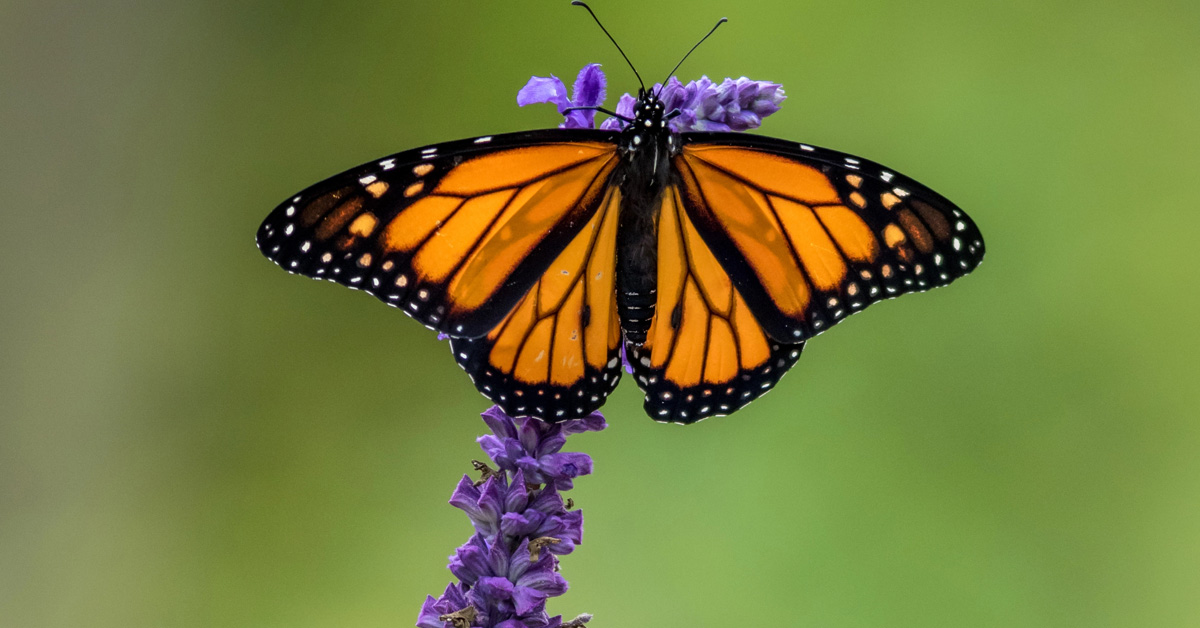
I smiled and wagged my head in a negative manner, “No Ma’am … but because of hunting, we have butterflies, particularly compared to those areas where there is no hunting! Personally, I really like watching butterflies in fields of wild flowers, as well as bees and other pollinators. If I see a lot of butterflies and bees, I know our wildlife management program, involving hunting, is doing its job of providing food and cover for all wildlife species including butterflies, song and game birds, non-game and game animals! Actually all wildlife benefits from hunting!”
“How can killing animals help butterflies?” asked she with a look of disdain.
Again I smiled, at the same time thinking, “Thank you. I so you hoped you would ask that question”.
“As a wildlife biologist I have had the opportunity to work with, and in many different types of habitat and terrain across the world. All too often, by the time I was called in to help, the property was in horrible shape. By that I mean most of the native vegetation was gone, eaten into the ground by too many animals. Without ground cover when it rained the soil eroded, taking with it seeds that had long been dropped to the ground where they waited to germinate. Over-grazing and over-browsing destroyed the plants which had lived there. With nothing to eat, the animals living there starved to death or, if they had the capabilities, moved to other areas, where left unmanaged they created the same problems of no food or cover, followed by soil erosion when it rained. All this because there was no hunting of the animals that lived on the property to properly conserve or manage the wildlife habitat, and to keep them from eating themselves out of house and home.”
“Without plants to hold the soil when it rains, and to produce vegetation; forage, seeds and fruits for insects, birds, small animals, large animals, wildlife cannot exist in those areas. One of the reasons for hunting is to sustain and keep wild populations from growing so large in numbers they destroy where they live. In many ways wildlife and wildlife conservation are not unlike a many-pieces puzzle, where all pieces are essentially the same size, but shaped differently. Increasing one or two pieces of the puzzle affects all the other pieces and the whole. If those pieces are increased they take space away from all the other pieces of the puzzle. The normal-sized pieces must adjust by decreasing in size. By continuing to increase the size of those one or two larger pieces, soon there is no more room for the smaller pieces. Eventually the smaller pieces will be decreased out of existence. They will be gone. At that point, the two larger pieces totally control the entire puzzle and the many smaller pieces (butterflies included) will be gone. Once that happens even the larger pieces will soon disappear. It is no longer a puzzle, simply one large mass that is no longer filled with life.”
“The role of sustained hunting is to try to keep all the pieces of the puzzle essentially the same size, uniquely shaped they may be, viable and all integral to each other, so there is room for all the pieces, which help each other continue to exist!”
“Butterflies, bees, as well as song birds are all pieces of that giant puzzle. If they are present, I know the overall habitat is in good shape. Hunting makes certain all the pieces of the puzzle are there in proper proportions where all things benefit. So we come back to butterflies. Beyond loving to watch butterflies, I know when I see them, the habitat and the animals that live in that habitat are in harmony, again thanks to hunting!”
“There is conservation and preservation. Conservation is the wise use of, thus conservation promotes life. Preservation concentrates on only one facet or animal and thus promotes death at the expense of everything around what is being preserved. A great example is the introduction of wolves in the West. By preserving wolves, they eat nearly every animal that was on the land; buffalo, elk, deer, black bear, as well as lesser animals and birds. Very little other wildlife remains where wolves have been introduced. Thus preserving wolves has done little more than kill other species. Know, too, wolves do not just kill to eat, they kill for many other reasons as well.”
“If you truly love wildlife, all wildlife, thank a hunter, not only for keeping habitat and animals at a level where all creatures benefit, but also because of the many millions of dollars hunters contribute through the Pittman Robertson Act of 1937 which provides money from the excise tax on the sale of guns, ammo, archery and hunting equipment to the State’s wildlife departments, and, through the sale of hunting licenses. Those hunter-generated dollars are then invested in non-game and game animals/wildlife, and habitat so all will exist long into the future! Remember, if you truly love wildlife thank the hunters. Without them there would be few, if any, butterflies!”