
by Luke Clayton – catfishradio.org
Living around wild hogs has become commonplace for many of us in Texas, and controlling their runaway numbers is a year around challenge. Wildlife biologists say it’s necessary to remove at least two thirds of the wild hog population each year in order to maintain existing numbers, and I think all of us that know hogs understand this is next to impossible to accomplish. One lone sow can set up residence in a remote creek bottom and quickly repopulate an area with a couple of litters each year and those offsprings do what hogs do so well- continue to multiply.
For those of us that are close to the land; farmers, ranchers, hunters, trappers, or property owners, wild hogs have become a costly plague that we often fight a losing battle to control. If you have ever bounced three feet off the seat of your John Deere while cutting hay when your tractor’s front tires disappear into a three-foot-deep hog wallow, you fully understand the damage wild porkers cause. Even those that might live in townhouses in very urban settings have to drive on the roads in “hog country” and woe to that speeding little red sports car that happens to connect with a wedge-shaped boar weighing a couple hundred pounds; the result is never good!
But I’m a hunter and have been my entire life. I absolutely love hunting wild hogs and turning some of the wild pork into tasty meals. Note I wrote “some of the pork”. I’m often asked if wild hogs are good to eat and my answer is really a posed question, “If you were going to a livestock sale to buy a hog to butcher, what would you choose, a rank old boar or a fat younger hog?” My question pretty much answers theirs!
I would be the first to admit that hunting will never keep hog numbers in check. In some ways it might do more harm than good to control hogs on a given tract of land. Swine are about fourth on the intelligence scale, below humans, primates, dogs and dolphin I’m told. Put too much pressure on a sounder of wild porkers and they are quick to vamoose to the next ranch, or farm, with no hunting pressure.
So, what you might ask is, what is the best method of keeping their numbers in check? Without a doubt it’s trapping. I’ve been an amateur hog trapper for much of my adult life. I have a little drop gate welded trap that catches them usually one at a time or sometimes two or even three little pigs, but it does little to actually control the number. Wise, older, trap-shy hogs are hesitant to walk into such traps. They can’t see daylight through the trap and often eat the bait right up to the door and refuse to go inside.
You might employ the services of a professional hog trapper to remove the hogs off your place but that can be costly and it’s often difficult to find a trapper on short notice when you need one. A sounder of ten or fifteen hogs can move onto a tract of land and do a great deal of damage before moving on. Or you might consider trapping them yourself with a trap that is easy to set, easy to move and can catch the entire sounder at one time.
I’ve spent a good bit of time visiting with Anthony Tew and learning about his P.I.G. hog trap (www.thepighogtrap.com). The letters PIG stand for Portable Interception Gear and the trap is aptly named. It is lightweight, highly portable, and can quickly be moved to intercept hogs where they are doing damage.
Anthony and his wife, Kari, own a company that has supplied netting to golf courses for years. Anthony is a lifelong hunter and decided to design a trap made from his companies durable netting that is light enough to ship economically and strong enough to catch and hold an entire sounder of wild porkers.
“There are other hog traps made of netting but none as heavy duty and durable as ours” says Anthony. “We use 7/16 inch treated rope for netting that is resistant to UV and lasts for many years. That’s why golf courses and government agencies use our materials.” The trap is ideal for folks that want to be in control of trapping on their land. When they notice invasive hogs doing damage, they can set the trap, and in a matter of a few days trap the entire sounder.
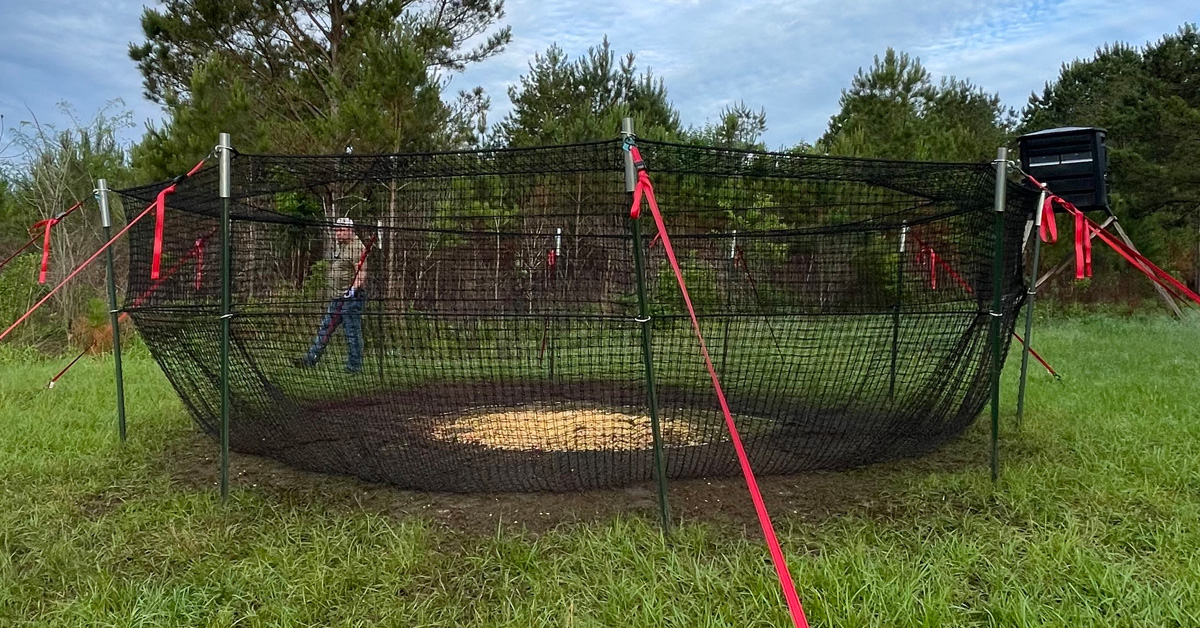
Setting the trap is simple. A radius point is first established for the center of the trap, and with a rope cut to the exact radius length, the T posts are laid out and driven into the ground. Support anchors are set and then the netting is put in place. It’s important to set the trap on level ground and remove any brush or tall weeds within the circle. The website has a great instructional video that walks one through the process.
Once the trap is set up, it’s important to pre-condition the hogs to go into the center for a night or two before actually ‘setting’ the trap. This is done by lifting the netting up from the ground in a couple places so that hogs can see all the way under the trap. This is one of the drawbacks of the box type traps that I have used in the past. Older, smarter hogs simply don’t like to go into tight quarters, especially traps that they cannot see through. A liberal amount of bait (usually corn) is placed on the ground in the center of the trap and a bit scattered outside the trap. Approaching hogs will quickly eat the corn on the outside and work their way to the smorgasbord in the center. The netting will be lifted from the ground just high enough that the hog’s back touches it as they work their way into the center. This preconditioning is necessary, it gets the hogs accustomed to going under the netting. It’s good to put a trail camera on the trap to observe the hogs that are attracted to the bait.
After a night or two of this preconditioning, the netting is simply lowered to the ground and the trap is set. Hogs are already accustomed to eating corn in the middle of the trap and when they approach and eat the few kernels scattered just outside the trap, they readily work their way under the netting to get to the feast in the middle. Once inside and after they have eaten all the corn, they quickly discover there is no way out! The trap works a bit like a minnow trap, they go in under the netting which is laying on ground and they are trapped. The netting is strong enough to hold the biggest boar. Even the biggest hogs are repelled when they run and hit the net, the tension on the net easily stops their charge and keeps them inside.
This P.I.G. trapping system is not the only way to trap hogs of course, the heavy traps with fencing and expensive cell phone activated drop gates certainly catches it’s share of porkers but for folks that want to take control of trapping entire sounders of hogs on their place, this system certainly deserves a close look. To learn more about this innovative trapping system and watch the videos, visit www.thepighogtrap.com
Luke Clayton writes a weekly outdoors column for Polk County Enterprise newspapers and host a weekly outdoor radio show/podcast “Catfish Radio with Luke Clayton and Friends” Catfishradio.org.