
by Todd Cashion
Spend enough time around farmers, ranchers, hunters, or fishermen, and you’ll hear stories that are hard to believe until you’ve seen it with your own eyes. One of those stories usually starts with an old fellow reaching behind the truck seat for two bent brass rods.
“We’ll just witch it.”
That’s all he’ll say.
No complicated explanation. No scientific lecture. Just a quiet confidence that somewhere beneath your boots lies a water line, an old well, a hidden spring, an unmarked grave, or something else waiting to be found.
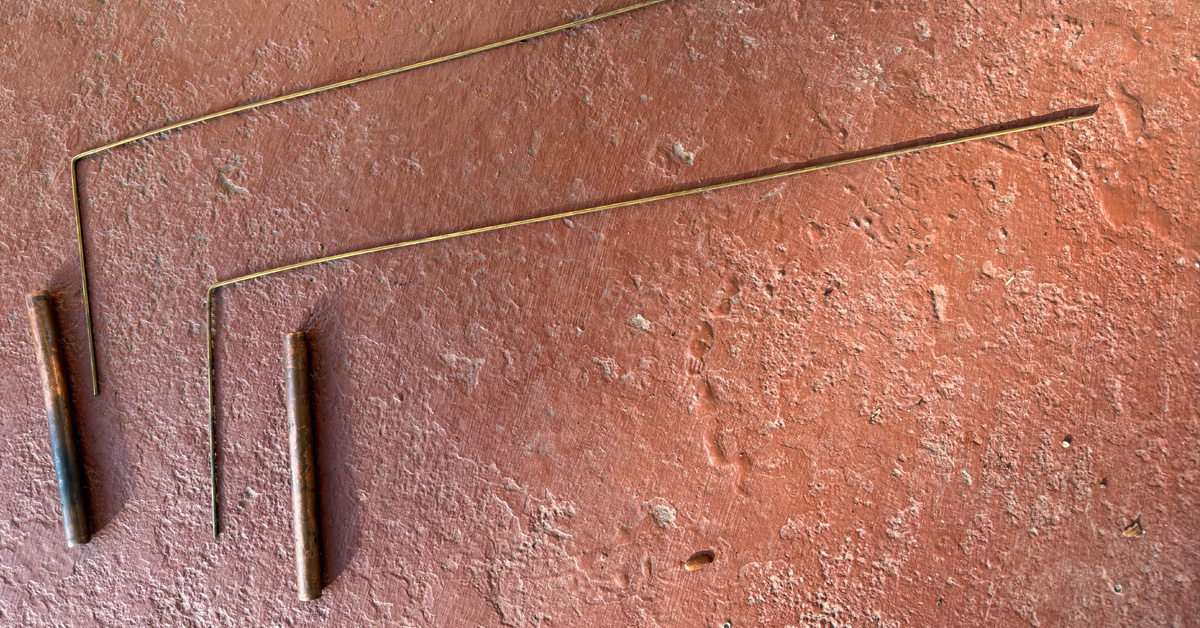
Whether you call it witching, water-witching, dowsing, or divining, it’s been part of country life for centuries. Long before electronic locators, satellite maps, and GPS, people depended on their eyes, experience, and sometimes a simple pair of rods or a forked tree limb. My setup is two 5 inch pieces of copper tubing, and 2 brass rods bent into an L-shape. Each hand holds a copper tube, and the short end of the brass L goes into the copper tubes, leaving the long portion out horizontal and level. The copper tubes allow the rods to move freely without any friction from your hands. The goal is to have both rods facing forward and level while walking the area. As you near the hidden source of water, the rods will spin inward and cross each other directly above the source. So, when the rods cross you drop an imaginary plumb-bob down from the crossed rods to the ground. That is where the digging occurs. You can try this on known underground utilities to get the feel of exactly how it works.
For generations, neighbors have argued about whether it actually works. The funny thing is, the arguments rarely change anyone’s mind. Some believe it works. Some call it witchcraft, and others just think it’s an old wives tale. Me? I believe it works though I can’t explain why it does.
“I don’t care what they call it,” an East Texas cattleman once said while smiling beneath a sweat-stained hat. “I’ve watched too many wells get drilled where those rods crossed.”
On old farms and home-places, finding water wasn’t just a convenience—it was survival.
A dependable well meant having drinking water, healthy livestock, thriving gardens, and a home place that could stay in the family for another generation. Drilling wasn’t cheap then, and it certainly isn’t now. Before spending thousands of dollars, many landowners wanted a respected local water witch to walk the property. Those men (and sometimes women) earned their reputations one successful well at a time.
Word traveled fast in rural communities.
“If Joe says drill here,” folks would say, “that’s where I’d drill.”
The tools themselves couldn’t be much simpler.
Some prefer two brass rods bent into an L-shape. Others swear by copper wire, or even welding rods. Plenty of old-timers still favor a forked peach, willow, or persimmon limb freshly cut from the edge of a pasture. Held lightly in the hands, the branch is said to dip toward the ground or the rods swing inward whenever the dowser passes over the object they’re searching for.
“I’ve tried to fool those rods,” the rancher laughed. “I’d tell myself they weren’t going to move. Then they’d cross so hard I’d almost drop them.”
Nobody seems to agree exactly why.
Scientists generally explain the movement through what’s called the ideomotor effect, tiny unconscious muscle movements that occur without the person realizing it. Controlled scientific testing has generally not shown dowsing to perform better than chance under experimental conditions. That explanation satisfies some people. Others simply shrug.
“My granddad couldn’t spell ideomotor,” an old farmer joked, “but he sure could find water.”
And that’s usually where the conversation ends.
Today, witching isn’t limited to wells.
Many rural landowners use brass rods while searching for buried water lines before running a fence, planting trees, or digging foundations. Others claim they’ve found septic tanks, sewer pipes, abandoned foundations, old cisterns, Indian graves, drain tile, forgotten fence corners, or long-buried utility lines.
One East Texas landowner recalled buying an older property where nobody knew exactly where the original water line had been installed decades earlier. “The plumber couldn’t find it. The previous owner couldn’t remember. My neighbor walked over with a pair of brass rods and had me digging in less than twenty minutes. We hit the pipe almost exactly where he marked it.”
Coincidence?
Maybe.
Good luck?
Perhaps.
Either way, stories like that continue to circulate across rural America.
Hunters have their own reasons for believing.
Every experienced deer hunter knows that water influences wildlife movement. During dry years especially, hidden springs can become magnets for deer, hogs, turkeys, and countless smaller animals.
Old springs often disappear beneath years of leaves, brush, and fallen timber until almost no visible evidence remains.
Some hunters carry witching rods while scouting unfamiliar property, believing they can relocate those forgotten water sources.
One longtime outdoorsman put it this way.
“If you can find the water, the deer will eventually find you.”
Fishermen tell similar stories.
Natural springs feeding ponds and creeks often produce slightly cooler, oxygen-rich water that attracts baitfish and game fish alike in hot weather. Along quiet shorelines, some anglers slowly walk with brass rods looking for places where underground water may be entering the lake.
Whether it’s proven science or simply confidence built from years on the water, many swear it helps identify productive fishing spots.
Of course, today’s technology offers remarkable tools. Professional utility locators can trace underground lines with astonishing precision. Ground-penetrating radar can reveal hidden objects. Geological surveys identify promising aquifers. GPS mapping has transformed the way land is managed.
Yet even with all that technology, plenty of folks still keep a pair of brass rods hanging on a nail in the barn.
Maybe that’s because witching represents something larger than finding water. It represents experience. It represents paying attention to the land. It reminds us that previous generations often learned lessons through observation rather than instruction manuals.
Country people have always trusted practical knowledge passed from father to son, and neighbor to neighbor. Some of those traditions eventually become accepted science. Others remain mysteries. Still others survive simply because enough people have witnessed something they can’t easily explain.
“I’ve quit arguing about it,” one retired farmer said while leaning against a pickup. “If somebody believes it doesn’t work, that’s their business. If somebody wants me to walk their place with my rods, I’m happy to help.”
Then he smiled. “And if we find what they’re looking for, I usually let them decide what happened.” Perhaps that’s the real charm of witching.
It sits comfortably somewhere between folklore and field experience, between mystery and memory. Around country stores, feed mills, hunting camps, and church dinners, it’s still a story worth telling.
Maybe the brass rods really are responding to something hidden beneath the earth.
Maybe they’re responding to something hidden within us.
Or maybe, like so many traditions handed down through rural America, the answer matters less than the stories shared while walking slowly across an open pasture, watching two simple rods point toward the unknown.
Sometimes the best part of country living isn’t finding all the answers. It’s keeping alive the stories that remind us where we came from.