
by Kelly Reeves
Remember when a pickup truck tailgate had exactly three jobs? All that was required of a tailgate was to stay shut while you drove, drop down when you needed it, and hold the weight of whatever you decided to put on it. That was it. No buttons. No warning lights. No camera. No fuses. No sensors. No user manual thicker than 1980 Sunday paper. A tailgate was a slab of steel, a couple of hinges, two cables, and enough strength to survive a lifetime of feed sacks, firewood, fence posts, hay bales, and a few careless kids climbing on it with muddy boots.
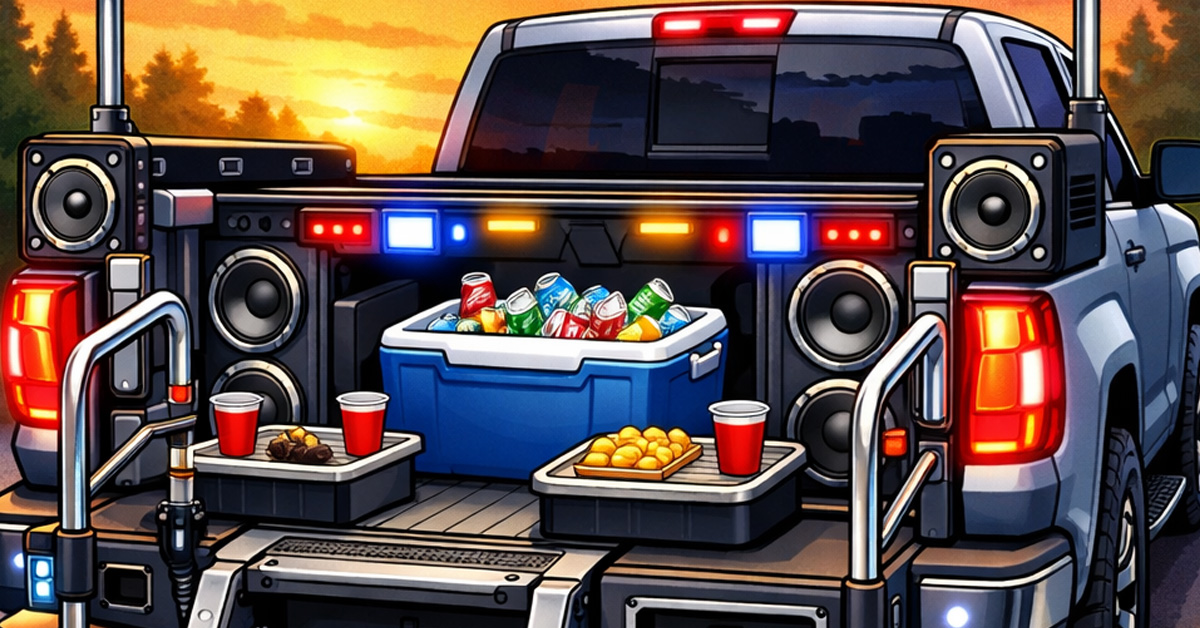
Somewhere along the way, though, the folks building trucks decided that wasn’t enough. Apparently a tailgate sitting there quietly doing its job wasn’t exciting anymore. Now we’ve got tailgates that fold, split, slide, light up, beep at you, lower themselves like they’re bowing to the Queen, and cost more to fix than the first truck I ever owned. Some have retractable steps, fold down hand rails, cameras, speakers, side-swing hinges, lights, power open, power closed, remote controls, and even 110 volt electrical outlets.
Modern tailgates are advertised like Swiss Army knives. “This one’s a step!” they say. “This one’s a desk!” Another one claims it’s a ladder, a workbench, a cooler stand, and probably has a place to charge your phone and update your social media while you’re loading mulch. On paper, it all sounds pretty handy. In real life, it mostly sounds expensive and fragile.
Take the electronic tailgate, for example. Push a button on the key fob and down it goes, slow and smooth, like it’s afraid of waking someone up. That’s real nice until the battery gets weak, a sensor decides it’s had enough, or you’re parked at a funny angle and the thing refuses to move because it thinks there’s danger lurking. Meanwhile, the old tailgate just drops when you pull the handle. No thinking. No arguing. Gravity does the work and never needs a software update. It opens with a “bang” loud enough that everyone in the area knows it opened.
Then there’s the multi-fold designs with hinges going every direction God and Henry Ford never intended. These things have more moving parts than a Hamilton pocket watch. They’re supposed to make loading easier, but half the time you need a quick lesson and a good memory to remember which latch to pull first. Pull the wrong one and you’ll swear you just broke something. And sometimes, you did. It may take two IT professionals and an ASE-certified mechanic get it back to somewhat functional.
All those fancy hinges and joints work fine when the truck is clean and parked on the dealer’s lot. Add a little dust, some grit, a little road salt, or a load of gravel that wasn’t perfectly centered, and suddenly things don’t line up like they used to. Tailgates start rattling, sagging, or refusing to close just right. That’s when the real fun begins, because fixing them usually involves words like “assembly,” “module,” and “not covered under warranty.”
And let’s talk about strength, because this is where the old tailgates really shine. The old-style tailgate was basically a steel bridge hanging off the back of the truck. You could sit three grown men on it, stack feed sacks shoulder high, or drag a deer up onto it without worrying about bending something. If it did get bent, you could usually straighten it out with a chain, a tree, and a little determination. Might not look pretty afterward, but that added character and it would still operate as intended.
Try that with a modern tailgate loaded with cameras, sensors, wiring harnesses, and plastic trim. One good whack and you’re not just bending metal—you’re risking cracked housings, damaged electronics, and a repair bill that makes your wallet moan. Half the time the dealer will tell you the whole unit has to be replaced. Not repaired. Replaced. As in thousands of dollars, assuming the supply chain is in motion.
Backup cameras are another fine example. I like a backup camera as much as the next guy, but did it really need to live inside the tailgate? On older trucks, if you dented the gate, you shrugged and kept hauling. On newer ones, that same dent can knock the camera out of alignment, trigger warning lights, or blow a fuse and shut down half the truck’s safety systems. Suddenly your tailgate isn’t just a tailgate—it’s a critical piece of the truck’s nervous system.
Then there’s the steps built into some tailgates. I’ll admit, they’re handy if you’re dressed in your Sunday best or climbing up gently. But watch what happens when they get packed with mud, ice, hay particles, or grit from that load of mulch your wife wanted. Springs stick. Latches jam. Plastic cracks. A good old-fashioned bumper step and a solid tailgate edge worked just fine for decades, and neither one cared if you were covered in cow manure.
The other thing nobody likes to talk about is how these fancy tailgates age. Trucks used to look better worn in. Scratches told stories. Dents had explanations and added character. Today’s tailgates age like cheap gadgets. Plastics get brittle. Camera lenses haze over. Electronics fail quietly and expensively. What was once a tough working surface slowly turns into something you’re afraid to scratch because you know how much it costs to fix.
Meanwhile, the old utilitarian tailgate just keeps doing its job. It doesn’t care if it’s scratched, muddy, or sun-faded. It doesn’t beep at you. It doesn’t argue. It doesn’t require a diagnostic scan to figure out why it won’t open. If the latch sticks, you spray it with WD-40. If a cable breaks, you replace it with one for $6 from the parts store. Simple problems with simple solutions.
I guess what really bugs me is that trucks are supposed to be tools. Good-looking tools, sure, but tools first. A tailgate doesn’t need to be clever or trendy. It needs to be strong. It needs to handle abuse. It needs to work when it’s cold, when it’s hot, when it’s dirty, and when you’re in a hurry.
There’s nothing wrong with progress, but somewhere along the way, tailgates stopped being built for work and started being built for brochures. They impress folks in parking lots, and on social media feeds, but they don’t always impress folks who actually use their trucks the way pickups were meant to be used.
Give me a plain steel tailgate with a solid latch and heavy-duty cables. One that opens with a “bang” when you drop it. One I can slam shut without flinching, sit on without thinking, and fix without taking out a loan. It might not fold into a picnic table or light up like a Christmas tree and play bluetooth Christmas carols, but it’ll still be working long after the gimmicks have quit—and that’s something worth holding onto.