
by Micah Lowrey
There was a time when a man looking for spawning bass in the spring had to rely on three things: a good pair of polarized sunglasses, a fully charged trolling motor battery, and the patience of Job. You’d ease down a bank, squint into the shallows, and hope to catch that pale dinner-plate circle fanned out on the bottom. Maybe you’d see the fish, maybe you wouldn’t. If the wind kicked up or the water muddied, you might as well have been hunting quail in a snowstorm.
Then along came forward-facing sonar, led by systems like Garmin LiveScope, and everything changed. Suddenly, anglers weren’t just looking at what had happened under the boat. They were looking at what was happening right now, out in front of them. Beds, bass, and your bait all sharing the same screen in real time. Thus was born a new spring bass fishing technique that some folks lovingly, and others begrudgingly, call bedscoping.
Bedscoping is the art of using forward-facing sonar on ‘Perspective” mode to locate and catch spawning bass on beds during the spring. It’s sight fishing without sight. It’s video gaming with a rod and reel. And whether you love it or roll your eyes at it, it has become a serious, though somewhat controversial tool in modern bass fishing.
Spring is when bass move to shallow waters to spawn. They fan out beds in protected pockets, along gravel banks, on the backs of flats, around docks, and beside isolated cover. Traditionally, anglers hunted these beds with their eyes. But forward-facing sonar lets you see beds even when the water is stained, the wind is blowing, or the fish are set up just a little deeper than you can visually detect.
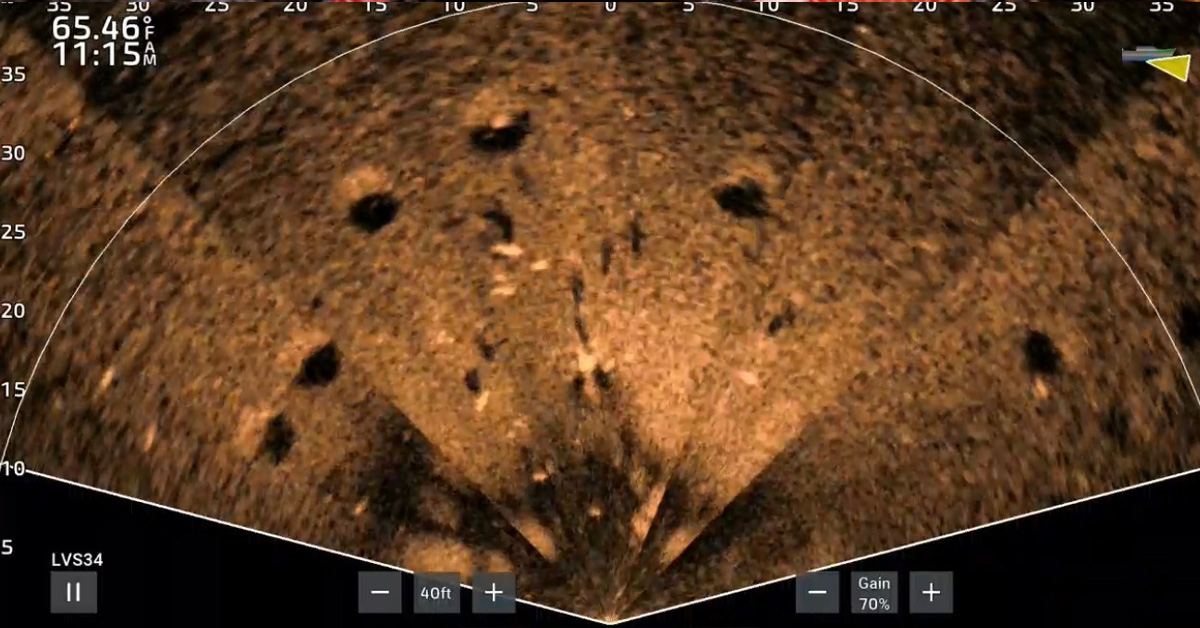
On your screen, a bed often appears as a bright, circular spot against a darker bottom. The fish itself shows as a solid return hovering nearby. When you pan the transducer around and see that unmistakable combination, it feels a bit like finding buried treasure. Except the treasure can swim off if you spook it.
Boat positioning is everything in bedscoping. The beauty of forward-facing sonar is that you don’t have to sit right on top of the fish. In fact, you shouldn’t. The closer you get, the more likely you are to push that fish off the bed. The trolling motor should be your best friend and your quietest accomplice. Ease into position from a distance and keep the boat far enough away that the fish never knows you’re there.
Most experienced bedscopers prefer to sit 30 to 60 feet off the bed, sometimes even farther in clear water. You want your sonar beam aimed slightly downward, scanning ahead of the boat. If the wind is pushing you, use it to your advantage. Approach from downwind when possible so you can hold the boat steady with minimal trolling motor input. The less noise and prop wash you create, the more relaxed that fish will remain.
One mistake beginners make is parking directly over the bed because they can see it on the screen. That might work once, but more often it sends the fish sliding off into deeper water, leaving you staring at an empty circle and wondering what just happened. Spawning bass are protective, but they are also cautious. Give them space and let your cast close the distance.
Casting accuracy becomes crucial. The real magic of systems like Garmin LiveScope is that you can see your lure in relation to the fish. Make a cast, watch the bait fall, and adjust in real time. If you land six feet short, you’ll see it. If you drop it directly in the sweet spot of the bed, you’ll know immediately.
Soft plastics are the bread and butter of bedscoping. Creature baits, compact craws, tubes, and stick worms all shine in this role. The key is something that can sit in the bed and irritate the fish. Spawning bass aren’t feeding aggressively. They’re defending. When your bait invades the bed and refuses to leave, it triggers that protective instinct.
White is a popular color for a reason. On sonar, you may see the bait, but being able to visually confirm it when conditions allow is helpful. A white or bright-colored soft plastic makes it easier to see when the fish picks it up. Sometimes the fish won’t swim off with it. It will simply flare its gills, inhale the bait, and move it an inch. If you’re watching the screen closely, you’ll see that subtle movement and know it’s time to set the hook.
Jigs also play well in the bedscoping game. A compact flipping jig with a craw trailer can be pitched past the bed and dragged into it. On the screen, you can watch the jig creep forward like an unwanted houseguest. When the fish noses down and the returns merge, it’s showtime.
Drop shots have quietly become a deadly bedscoping technique as well. Instead of dropping vertically under the boat, you cast beyond the bed and shake the bait in place. The weight anchors it while the soft plastic dances above the bed. Watching a fish inch closer on sonar, flare up, and finally commit is as nerve-wracking as watching a bobber tremble.
Line choice matters more than ever. Fluorocarbon remains popular for its low visibility and sensitivity, but braided line with a fluorocarbon leader gives you the control and immediate feedback that bed fishing often requires. When you see the fish turn with your bait on the screen, you don’t want any delay in driving the hook home.
The advantages of forward-facing sonar for bed fishing are obvious. First, it expands your vision. You can locate beds in slightly deeper water that would be invisible to the naked eye. Many bass spawn just beyond traditional sight-fishing depth, especially in pressured lakes. With sonar, those fish are no longer safe just because they chose four or five feet instead of two.
Second, it reduces wasted time. Instead of blind casting to every likely-looking stretch of bank, you can scan ahead and identify actual beds and fish before ever making a cast. In a tournament setting, that efficiency can be the difference between a check and an early ride home.
Third, it allows you to read fish behavior in real time. You can see whether the fish is locked on the bed or roaming. You can tell if there’s a second fish nearby. You can watch how the bass reacts to different baits and adjust accordingly. It turns bed fishing into a chess match instead of a guessing game.
But bedscoping is not without controversy. Some anglers argue that using forward-facing sonar during the spawn removes too much mystery and challenge from the sport. They feel that part of the tradition of spring fishing is relying on water clarity, stealth, and old-fashioned woodsmanship, or lakemanship rather. There’s a certain romance in easing down a bank with nothing but sunglasses and instinct.
There are also conservation considerations. Spawning bass are vulnerable. When you repeatedly catch fish off beds, you temporarily remove them from guarding eggs or fry. In heavily pressured lakes, excessive bed fishing can impact recruitment. While most bass are resilient and return quickly, responsible anglers should consider limiting how many bedding fish they target, especially in smaller bodies of water.
In some cases, not using forward-facing sonar can be a deliberate choice to preserve the sporting aspect of the spawn. It forces you to read the bank, understand seasonal movements, and develop a deeper connection with the water. There is value in that, especially for younger anglers learning the craft.
Additionally, forward-facing sonar is expensive. High-end systems like Garmin LiveScope represent a pretty significant investment. Not every angler has access to that technology, and some feel it widens the gap between weekend fishermen and well-funded competitors.
Still, like any tool, it comes down to how it’s used. Bedscoping can be done responsibly and ethically. Practice selective harvest. Handle fish quickly and return them to their beds. Avoid repeatedly catching the same fish for sport. Use the technology as an aid, not a crutch.
At its heart, bedscoping is simply the evolution of spring bass fishing. Anglers have always used the best tools available, from cane poles to graphite rods, from paper maps to GPS mapping. Forward-facing sonar is just the latest chapter.
And truth be told, there’s something undeniably thrilling about watching a five-pound largemouth hover over her bed on the screen. You make a cast, see your bait settle in, and watch her tilt down to inspect it. Your heart thumps. The line tightens. The screen lights up in a chaotic blur as fish and lure collide.
It may look like a video game, but when that rod bows and that bass surges toward deeper water, it feels just as real as it ever did.
Whether you embrace it wholeheartedly or prefer to leave the screen dark during the spawn, bedscoping has carved out its place in modern bass fishing. It has changed how anglers approach shallow water in the spring and added a new layer of strategy to an old seasonal ritual.
In the end, the bass still has the final say. You can see her. You can watch her. You can tempt her. But you still have to make the right cast, present the right bait, and set the hook at the right moment.
Technology may have sharpened our vision, but it hasn’t replaced the thrill of fooling a fish that’s guarding the next generation. And that, screen or no screen, is what keeps us coming back every spring.