
by Larry “Mr. Whitetail” Weishuhn
A pair of red-tailed hawks circled overhead hoping to spot the distressed cottontail. Incoming crows increased their cawing as they drew closer, if for no other reason than to aggravate the hawks. At least something was responding to my efforts.
Sitting, my back against a gnarly mesquite, open-sight Rossi R95 .30-30 Winchester rested in the crux of my crossed shooting sticks in front of me I patiently waited in great anticipation. Fifty paces out in front, my Burnham Brothers’ Freq ultra-sonic electronic call broadcast its direly distressed cottontail rabbit high pitched squeals. The circling raptors remained interested, even if it meant tolerating the raucous crows.
Texas’ mid-afternoon sun intensified late spring temperatures making it feel really warm, nay, hot. Sweat beaded on my forehead and threatened to drool into my eyes.
My mind drifted to a time many years earlier when I first blew into a Burnham Brothers C-3 mouth-blown predator call, hunting across the road from our rural home. I got so excited when a “wolf” charged toward me I emptied my dad’s Model 94 lever-action .30-30 without so much as cutting a hair. Recalling that first experience of calling predators, I nearly laughed out loud. Even though I had embarrassingly missed seven rushed and utterly excited shots, I knew one thing for certain from that encounter. I was not about to quit calling predators, ever!
Crows cawed, perched in the top-most limbs of nearby mesquites. I sat statue still enjoying their caws while waiting patiently for a four-legged predator to make an appearance. My reason, partly, for calling predators during late spring was to remove coyotes, bobcats and raccoons just before the whitetail deer fawning season. That and the fact I dearly love calling critters. And yes, raccoons can and do occasionally kill fawns.
Predators have their place in the natural world, but sometimes their numbers need to be reduced or regulated. In this instance the young families who hunted the property wanted to be able to harvest more fall venison. The primary means to accommodate their wishes was to increase the deer population by upping fawn survival rates. More fawns added into the population would result in added deer harvests opportunities. Competing four-legged predator numbers needed to be reduced to accomplish this.
Does in the immediate area normally “started dropping” fawns during late May and early June. I hoped to remove as many predators as possible just before fawns were born.
Thankfully the property conducted a proper rotational livestock grazing program which insured ample habitat for whitetail deer. The immediate area had received excellent rainfall during the winter creating considerable spring ground cover. Ground vegetation not only provides food for livestock and wildlife it also creates excellent hiding cover for new born fawns. With such vegetation predators have a harder time seeing and finding young fawns.
During the first week of their life, fawns instinctively lie down and do not move from where the doe leaves them. They remain death-like still no matter what approaches or walks by. Predation during these first days is usually minimal. Fawn predation primarily starts occurring once they get a bit older, when they jump and run from approaching danger. This is when coyotes and bobcats take their toll.
What of wild hogs? They too can be serious predators on fawns, Thankfully the property had an on-going feral hog removal program including continual trapping. Having done so for several years this has greatly reduced wild hog predation of fawns.
Prior to my hunt, I visited with Burnham Brothers Game Calls’ Gary Roberson. Gary, because of a lifelong pursuit of predators and his ever-continuing research, knows more about hunting coyotes and bobcats than anyone. He too, is the host of the extremely popular Carnivore television show which airs on Pursuit Channel. Based on his many years of hunting and studying coyotes and bobcats he, with the assistance of professional sound engineers, created the revolutionary Freq (www.freqcalls.com) the world’s first ever ultra-sonic electronic game call. The process Gary and his team created records distressed prey sounds at their real and true ultra-sonic frequency, measured in Hertz. The Freq broadcasts those extra high-pitched frequencies and the low “growling” sounds made by distressed prey species.
Research demonstrates coyotes can hear upwards of 45,000 Hertz. Bobcats can hear upwards of 65,000 Hertz, the same and slightly higher ultra-sonic sounds produced by distressed prey such as cottontail and jack rabbits. All existing electronic game calls, shy of the Freq, broadcast sounds only up to 17,000 to 18,000 Hertz, no matter how high the volume is turned up or other adjustments made.
Burnham Brothers’ Freq produces and broadcasts distressed prey calls at 55,000 Hertz. That’s what sets the Freq call so far apart from, and above any other electronic game call on the market. It broadcasts sounds at Hertz levels predators actually hear. This is the reason predators respond so consistently to the Burnham Brothers’ Freq, and why it brings in call-shy predators, coyotes and bobcats, that have quit coming to “regular” electronic calls.
I asked my old friend to tell me about some of his latest predator hunting adventures. Gary hunts predators a lot! I recorded our conversation for my weekly “DSC’s Campfires with Larry Weishuhn” podcast episodes, available on Spotify, ApplePodcasts, iHeartPodcasts, outdooraction.com, waypointtv.com, carbontv.com and many other places. Knowing I would soon be calling with my own Freq, I asked him what to expect calling in upcoming warm weather, as well as what advice he might have for my doing so.
“I really don’t do things differently when its warm to hot compared to what I do calling in cold temperatures. Just remember it does no good to call in critters and not see them when the respond. Always set up where you can see coyotes or bobcats coming in to the call. Maybe just as important is to be patient. When the temperatures are warm to hot coyotes are slower in responding. Bobcats nearly always are a lot slower about coming in than coyotes, even during cool to cold weather. When it starts getting hot cats can be really slow in responding. Be patient, really patient before leaving a set up,” suggested Gary.
“I really don’t do things differently when its warm to hot compared to what I do calling in cold temperatures. Just remember it does no good to call in critters and not see them when the respond. Always set up where you can see coyotes or bobcats coming in to the call. Maybe just as important is to be patient. When the temperatures are warm to hot coyotes are slower in responding. Bobcats nearly always are a lot slower about coming in than coyotes, even during cool to cold weather. When it starts getting hot cats can be really slow in responding. Be patient, really patient before leaving a set up.” Suggested Gary.
Presently, I was taking Gary’s statement to heart and practice, waiting patiently. Like him, I call predators only during daylight hours. I want to see critters approach watching how they respond. I suppose I could use some the night-time tools such as the various thermal devices we have these days to do some watching, but no. Maybe someday, or rather night. But for the time being, I will only call predators during daylight hours. Guess, I’m old school.
Gary and I also talked about our current firearms and ammo choices. Said he, “As I’ve gotten older I’m more and more drawn back to where I started, hunting with open-sight lever-action rifles. The only “new” in my current predator hunting kit is our Freq call and Hornady’s LEVERevolution ammo. I mostly hunt with an open-sight Ruger/Marlin Model 336 .30-30 Win. I guess it’s new in that Marlin is now owned by Ruger. Really like that rifle/ammo combination.”
“Calling coyotes or bobcats should be a close range game. Lever-actions are ideal for that kind of hunting. They’re quick to point, accurate and fun to hunt with. If a follow-up shot is available or required, sometimes I even amaze myself how quickly I can accurately shoot a second or even a third shot.” Added Gary.
“I appreciate and love my bolt-action Mossberg rifles. I truly enjoy hunting with them and shooting steel targets at long range. I particularly like my 7mm PRCs Patriot Predators topped with Stealth Vision scopes and shooting Hornady Precision Hunter ammo. Although I can accurately shoot those rifles at steel out to 1,200-yards, when it comes to hunting I want to get as close to the animal as possible before pulling the trigger.”
“Frankly however, I often find myself grabbing one of my Rossi lever-actions R92s chambered in.45 Colt and .44 Mag, or my .30-30 Win Rossi R95 when calling predators, hunting hogs and even deer. Doing so takes me back to my early days of hunting!” I commented.
“Yessir, there’s also something really “comforting” about hunting with a lever-action. I’ve pretty well decided from here on to do most all my hunting with a lever-action rifle and occasionally a single-action revolver.” Stated Gary.
Meanwhile back on the hunt, it had not gotten any cooler. Thankfully there was a slight breeze, but not blowing hard to the point of messing up the calling. I sat patiently and waited, remembering Gary instructions to be patient, real patient.
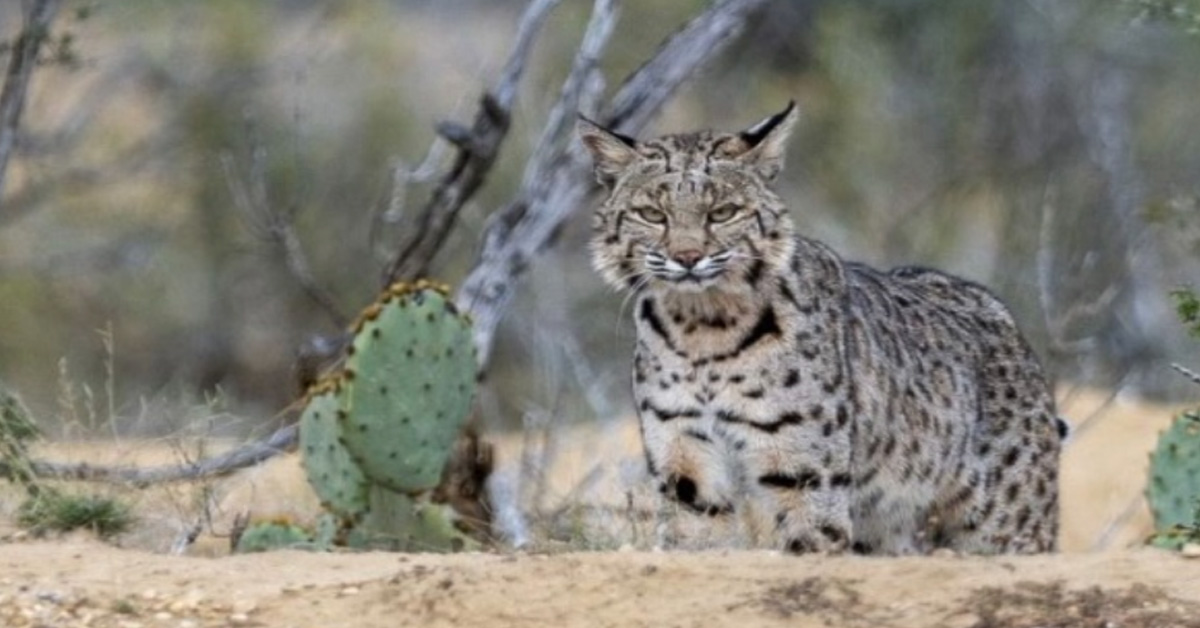
After twenty minutes without any obvious four-legged responders, I was just about to get up to walk back to my Jeep and drive to another location. Just then I spotted slight movement coming my way, a deliberate and slow moving bobcat. Patience indeed was about to pay dividends.
Should you wish autographed copies of Larry Weishuhn and Luke Clayton’s CAMPFIRE TALK and POOR MAN’S GRIZZLY or Larry Weishuhn’s DEER ADDICTIONS books please go to larryweishuhn.net and
catfishradio.org.